
An omnibus survey gives organizations a way to put their own questions to a shared research audience, with the provider managing the fieldwork and spreading its cost across participating clients. For a team with a focused question about awareness, attitudes, or consumer behavior, that can make a broad survey more practical than commissioning a separate study.
At Mercury Analytics, our monthly omnibus reaches 1,000 US general-population respondents on the second Wednesday of each month, with complete results available within 24-48 hours of launch through our Analytics Workbench. Whether that format is right for a particular brief depends on who the team needs to hear from, when it needs the findings, and how much detail the decision requires.
A national awareness check, for example, asks something different of a survey than a study of specialist business buyers. Working through those requirements early helps establish whether an omnibus can provide the evidence needed.
How does an omnibus survey work?
The process usually begins with a business question, such as how familiar consumers are with a topic, what concerns them about a purchase, or how they interpret a proposed message. The research team can then help turn that question into a brief and identify any audience comparisons that will matter when the findings arrive.
There are five useful steps to work through with the team:
- Define the audience segments and the decision the findings will inform, including the date by which they must be usable.
- Agree the questions and scope, allowing time to review wording, response options, and routing before confirming the submission deadline and quote.
- Confirm the time in field, including when the survey launches and when results will be delivered.
- Agree quality checks and analysis, including any response exclusions and demographic comparisons. The full sample is weighted to the general population, and our research team can show you how to set your own weights for segments of interest in the Analytics Workbench.
- Review the findings against the original question, checking the data matches the source before using a result in a presentation or public claim.
These details belong in the project brief, where both your team and the research team can refer back to them if questions arise during analysis.
What does nationally representative mean?
A nationally representative survey is designed to reflect a defined national population, with that claim depending on how the sample is recruited and balanced. The number of respondents matters, but a sample of 1,000 people needs a suitable research design to support conclusions about the wider population.
Our omnibus sample is nationally representative by region, age, gender, household income, ethnicity, and political affiliation.
Can you analyze smaller audiences?
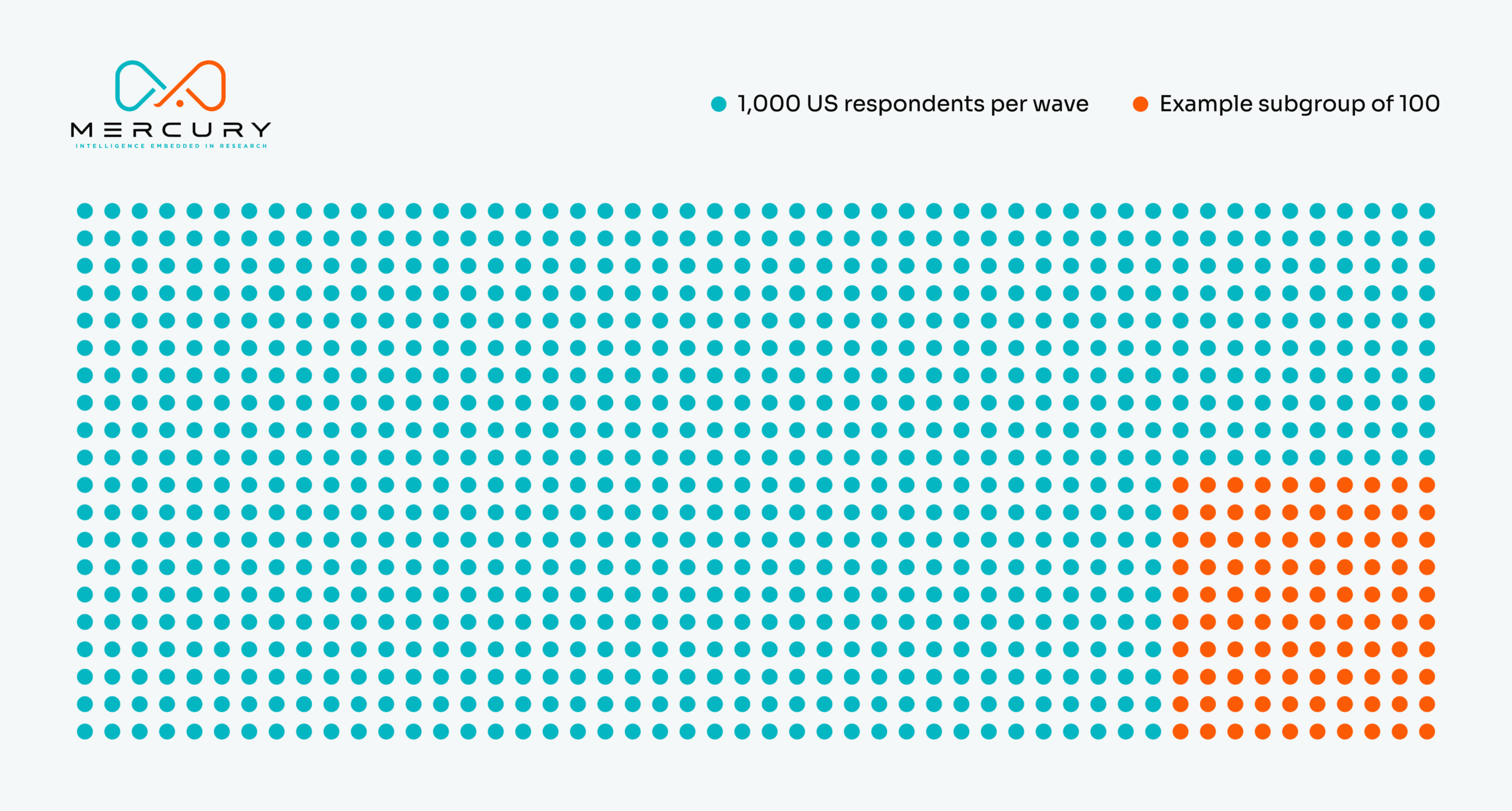
Subgroup analysis is best planned before fieldwork, especially when a national result will be broken down into smaller audiences. In a hypothetical sample of 1,000 respondents, for example, a group containing 100 people would provide a base of 100 for that group’s findings. Identifying or estimating statistically significant sample sizes for segments of interest within the general population is fairly simple, depending on the characteristics of the segment.
Our research team can advise whether the anticipated base is sufficient for the decision or whether additional respondents from that group would be needed. A targeted study may also be appropriate, depending on availability, cost, and the level of detail required.
How quickly will you receive results?
The schedule includes both the wait for the next survey and the time needed to deliver results after launch. Our omnibus runs on the second Wednesday of each month, with results available within 24-48 hours of launch. Questions can be submitted up to 12 hours before the survey launches, so there is usually time to have your questions added. If timing does not work out, a custom survey may be worthwhile.
Should you choose an omnibus or a custom survey?
The choice comes down to the audience, schedule, and amount of control the study needs. An omnibus may fit a small set of questions for a broad population, while a custom research brief gives the team scope to discuss more specialized requirements.
| Requirement | Consider an omnibus | Discuss a custom study |
|---|---|---|
| Questions | A focused set within a shared survey | A long or interconnected questionnaire |
| Audience | A broad population matching the sample | Specialist buyers or narrowly defined groups |
| Analysis | National findings and feasible subgroup comparisons | Detailed analysis of several small segments |
| Schedule | A scheduled wave fits the deadline | Fieldwork needs its own schedule |
| Context | Shared questionnaire conditions are suitable | Greater control over the full respondent experience |
For a hypothetical household-spending brief, a communications team might want to understand which expenses consumers expect to reduce and why. Before booking, it would need to define the period covered by the questions, review the response options, and decide which audience comparisons could affect its plans. Once the findings arrive, those choices give the team a basis for assessing whether the proposed story is supported.
Questions to ask before booking
- Can other clients see the questions or results? No. In Mercury Analytics’ omnibus surveys, your questions and results are confidential to your organization and are not shared with other clients participating in our omnibus.
- Can the survey include images or video? Our omnibus supports media-testing tools and qualitative and quantitative question types. The specific asset, format, and price still need to be agreed around the brief.
- Can the same question run every month? Yes. Repeating questions can help track population trends, provided the wording and analysis remain consistent across surveys. If you want to follow changes in the same individuals over time, get in touch to discuss a potential longitudinal panel design.
- What will the team receive? Your results are available through our Analytics Workbench, including segmentation, crosstabs, ratings, open-ended responses, and Ask MercuryAI. Any additional reporting or export requirements can be agreed before fieldwork, particularly if results need to feed into an existing reporting process.
To explore a forthcoming study, contact our team by clicking here with the intended audience, proposed questions, and deadline. Those details will help establish the next suitable wave and the scope of a quote.